I have stayed at W Amsterdam, the Conservatorium and De L’Europe, and De L’Europe is the one I would choose again. That is not because it wins every comparison. W had the better gym, and my suite there was memorable in a much more extravagant way. At De L’Europe, I stayed in a junior suite with a small balcony. What stayed with me was the feeling of the hotel as a whole: warm, personal and right on the water, in a part of Amsterdam where I wanted to be.
I was there during Amsterdam Dance Event in October 2024. That gives the preference some context. A hotel during a busy city trip has to work between the things you came to do. Its character shows in the ordinary intervals, when you have returned without an occasion to dress for and want to feel comfortable being there. De L’Europe made that kind of impression on me. It felt like somewhere I could settle into, rather than a hotel I was trying once for the room.
01A grand hotel with warmth
The phrase I used for De L’Europe was that it felt family-run. That describes my experience of its manner, rather than its corporate structure: the hotel's own history traces its association with Freddy Heineken and identifies its present owner as the HEINEKEN company. The grand hotel on Nieuwe Doelenstraat opened in 1896. It has the history and position to be quite imposing, but that was not the quality that dominated my stay.
There is a design explanation for some of that feeling. Nicemakers’ 2020 redesign combined the existing classical language with softer forms, warm colors, substantial curtains, antiques and furniture made for the project. The work extended through bedrooms, restaurants and public spaces. I find that useful context because warmth in a hotel is partly a matter of what a room invites you to do. A formally furnished interior can still feel lived-in if its different elements sit comfortably together.
The distinction matters to me in Amsterdam. I enjoy a hotel with a strong personality, including the energy of W. I also want that personality to remain enjoyable after the first impression. De L’Europe's appeal was less dependent on a spectacular feature in the suite. The atmosphere carried through the stay. I came away thinking about returning to the property, rather than trying to recreate one exceptional upgrade.
02Location on the Amstel
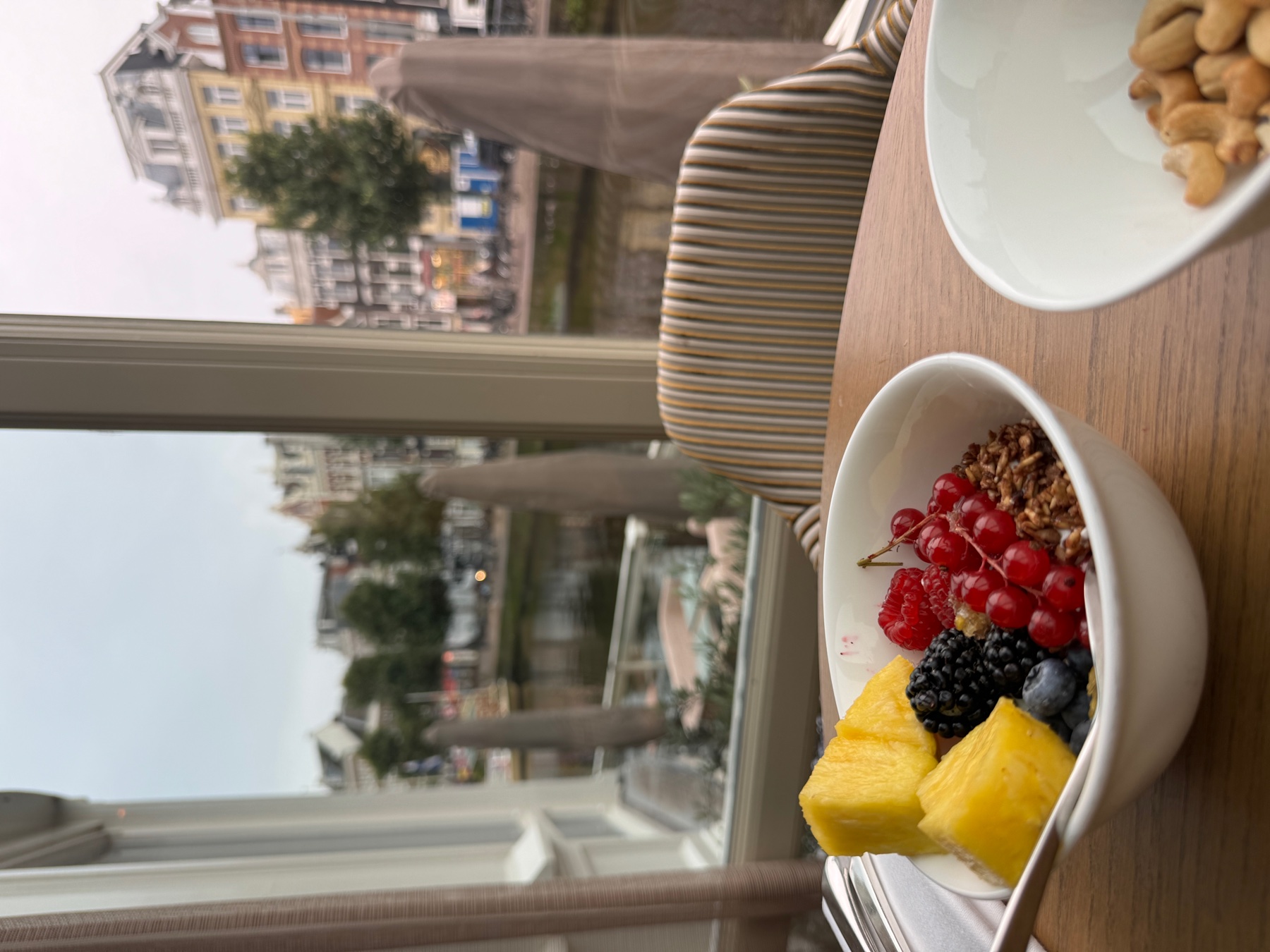
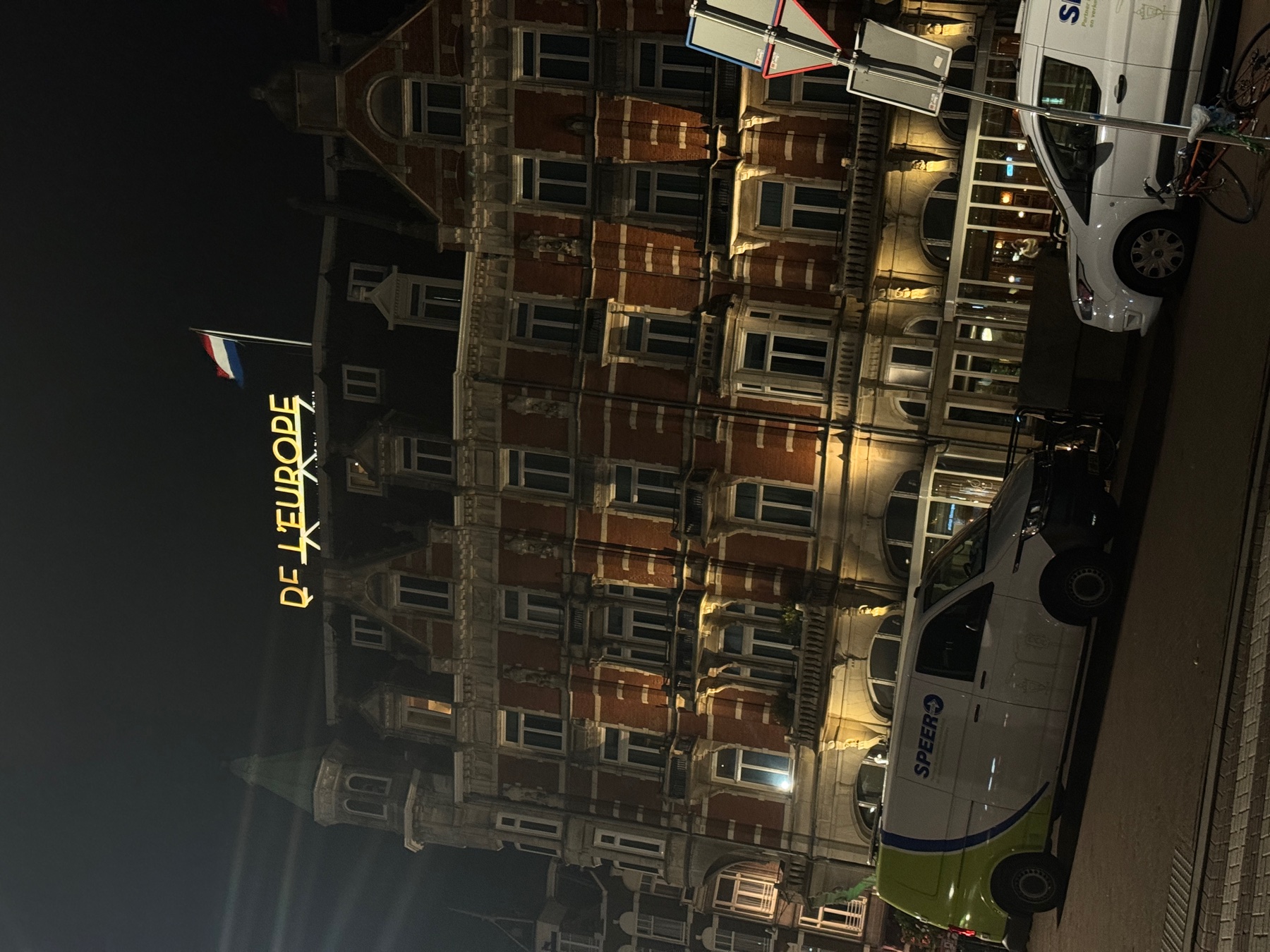
I tend to describe the setting as canal-side, because the water is central to how I remember it. More precisely, De L’Europe stands on the Amstel, at the edge of the historic canal belt. The river gives the building an open aspect that differs from being tucked into a narrow street. My photographs include the hotel at night and a breakfast setting by a window over the water. Even without turning a meal into an event, that is a good relationship between a city hotel and its surroundings.
The hotel also provided bicycles. That matters because a central address and access to a bike complement each other: the address gives you somewhere useful to start, while the bike lets the day extend beyond the immediate neighborhood. I like being able to make a city stay active without treating every excursion as a transport arrangement. In Amsterdam, that is a more meaningful advantage to me than another elaborate room amenity.
The contrast with the Conservatorium is personal rather than a claim that one location is universally better. It felt farther out for the way I was using Amsterdam, although I returned there for lunch during this trip. I liked having De L’Europe as my base and another hotel as somewhere to visit. Choosing where to sleep does not require choosing where every meal or afternoon has to happen.
That flexibility was particularly relevant during ADE. Its 2024 program ran from October 16 to 20, with events spread across the city. A central hotel cannot be beside every venue in a distributed festival. What it can offer is a base whose neighborhood remains worthwhile when there is nothing on your schedule. De L’Europe suited the Amsterdam around the event, which is a better reason to choose it than assuming one hotel solves the entire festival's geography.
03The junior suite with a balcony
The small balcony is the room detail that stayed with me. It gave the suite a connection to the city beyond its furnishings. I would not turn that memory into a promise that every junior suite has the same outdoor space: the current room collection distinguishes junior suites from a separate Deluxe Suite River View & Balcony category. My historical room description is a junior suite with a small balcony; those modern names should not be used to rewrite the stay.
There is a useful choice within that distinction. The hotel currently lists junior suites at 40–50 square meters, while the river-view balcony suites add a separate sitting area within a larger footprint. If I were returning, I would prioritize the actual outlook and outdoor space over moving up a category simply for the name. The balcony was a specific pleasure. A higher category would only improve the stay for me if it preserved or strengthened the things I liked.
04The gym: the one compromise
De L’Europe's gym disappointed me compared with W Amsterdam's. Fitness is important enough in my travel routine that this is a real limitation, not a detail I would hide because I liked the rest of the hotel. If the gym were the deciding factor for a particular trip, W would have the stronger case based on my experience.
It did not decide this one. I preferred De L’Europe's warmth, its position on the water and the overall feeling of staying there. That is the tradeoff I would carry into a return booking. A review becomes less useful when affection for a hotel erases its weaker areas; the gym is precisely where someone with different priorities might reasonably make another choice.
For current dining planning, Brasserie Marie is the hotel's French brasserie beside the Amstel, with indoor seating and a terrace used in the warmer seasons. The menu on its website is a useful starting point for arranging a meal around the setting. My strongest recommendation here concerns the hotel, rather than a remembered signature dish. I would go back for the combination that made it feel personal: a room with some outdoor space, the river alongside it, and central Amsterdam beyond the door.