The part of Conservatorium I remember most clearly is the contrast between the old building and the glass courtyard. I described the historic architecture as almost monastery-like, but the actual story is different: this was a bank, then a music school, before it became a hotel. The modern intervention does not try to disguise itself as another piece of the old building. That is what makes the place so distinctive.
I have stayed here and later returned for lunch while staying at De L'Europe. That return is a useful measure of its appeal. Conservatorium was not my preferred Amsterdam base, yet I still wanted to spend time in it. The architecture and café gave it a place in the trip even when I chose a different hotel for the night.
My experiences predate its January 14, 2026 transition to Mandarin Oriental management. It now operates as Mandarin Oriental Conservatorium, Amsterdam. The building remains recognizable, but current dining and room updates belong to a new chapter; my earlier visits should not be mistaken for an assessment of the new management's service.
01The Conservatorium courtyard and lobby
The hotel occupies the former Rijkspostspaarbank, later used by the Sweelinck Conservatory of Music. Mandarin Oriental's history of the property identifies Piero Lissoni with its conversion into a hotel, which opened in 2011. That sequence explains both the weight of the historic exterior and the name. The building's atmosphere may suggest a cloister to me, but its institutional past was financial and musical.
MVSA Architects' account of the conversion explains the most striking part of the design. The new glass atrium occupies the inner courtyard and contains the reception and public hospitality spaces. A contemporary staircase and a floating volume for meeting rooms and lifts sit against the old brick and tile. The architects deliberately used the contrast to make the inherited building easier to see, rather than copying its details in new materials.
That is why the courtyard works so well as a hotel space. It retains the sense of being enclosed by a substantial old building, while the glass opens the room to light and creates a different scale of interior. The visual interest comes from being able to understand both parts at once. The old structure supplies character, and the new one makes room for the way a contemporary hotel wants people to gather.
I find Amsterdam stylish generally, so it takes more than fashionable furniture to make a property stand out. Conservatorium has that extra dimension. Its design changes the experience of occupying the building, not just the appearance of a room in a photograph. It is the part of the hotel I would most confidently recommend someone experience, including a traveler who already has somewhere else to stay.
02Location: Amsterdam's Museum Quarter
I found Conservatorium further out than W Amsterdam and De L'Europe. That is a statement about the Amsterdam I wanted around me, not a claim that the hotel is inconvenient for everything. Its Museum Quarter location places it opposite the Stedelijk and close to the Van Gogh Museum, Rijksmuseum and Vondelpark. For a visit built around those institutions, the same address becomes a considerable advantage.
The distinction is between different centers of activity. A hotel beside Dam Square supports a different immediate itinerary from one beside the museums. I liked being able to visit Conservatorium's café and appreciate the building, while still preferring De L'Europe's waterside setting as my return base. Those choices can coexist because a hotel does not have to provide every part of a city visit to be worth knowing.
For someone planning several museum visits, the concentration around Conservatorium would reduce the need to cross the city between outings and the hotel. It also gives a clear answer to what the neighborhood is for. I would choose it because that particular part of Amsterdam suits the trip, rather than assuming that the most celebrated interior automatically supplies the most useful location for every visitor.
03A private driver for a day trip from Amsterdam
During a spring trip around King's Day, I wanted to visit Keukenhof, and the hotel arranged a driver. That was a concrete piece of concierge help: it connected something I wanted to do outside Amsterdam with the hotel I was using inside it. The arrangement belongs to my Conservatorium experience, separate from the extensive cycling and tulip-field memories associated with my W Amsterdam stay.
Keukenhof's own visitor information places the garden in Lisse, not in central Amsterdam, and publishes a limited spring opening season. For 2027, that season is March 18 to May 9. The distinction matters because a visit depends on both transport and timing. The hotel helped with the transport on my trip; the excursion was not simply something available whenever I stepped outside the door.
A driver was useful to me because it made the outing straightforward. It was not evidence that every stay includes a free excursion, nor a reason everyone needs private transport. The value of the concierge was in arranging the experience I had chosen. That is more persuasive than a general promise that staff can organize anything: there was an actual destination and an actual journey they helped put together.
04Lunch then, a different restaurant now
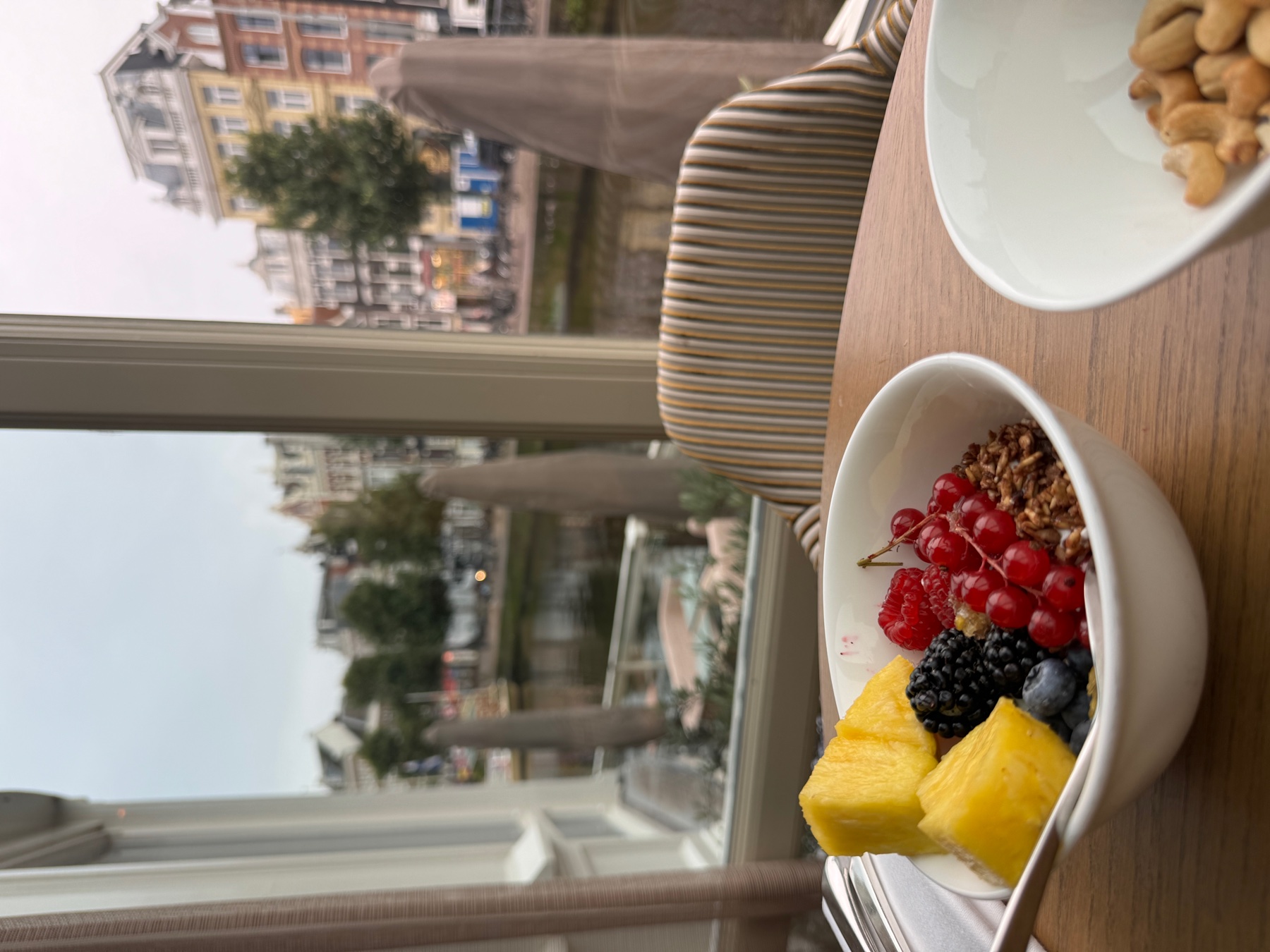
I liked the café setting enough to return for lunch during my later De L'Europe trip. The public courtyard was an attraction independent of my earlier bedroom reservation. I do not remember dinner well enough to recommend particular dishes or turn the visit into a comprehensive food review.
The dining offer has since changed. The current Ottolenghi Amsterdam page and menus describe a vegetable-led Mediterranean approach, including fermentation and cooking over fire, with breakfast, lunch and dinner service. That is useful current context for someone visiting the atrium now. For a returning visitor, the setting may be familiar while the meal is a new experience; my earlier lunch predates this restaurant.
05What I would choose it for
I remember work being done around the gym and spa during my stay. That limits my historical assessment of those facilities. The current Akasha wellness information describes a gym, treatment spaces and an eighteen-metre lap pool, but it does not turn my earlier recollection into a review of today's operation. Fitness was a clearer firsthand strength at W Amsterdam.
Among Conservatorium, the W and De L'Europe, I would still choose De L'Europe first for another Amsterdam stay. Conservatorium's case is more specific: remarkable architecture, a useful Museum Quarter address and public spaces that brought me back even while sleeping elsewhere. A hotel that can earn that return has achieved something substantial. I would recommend it to someone whose itinerary fits its neighborhood, or simply make time for the courtyard when the room is booked somewhere else.